

There is frequently much discussion as to why we cycle slower in winter than in summer. There are several reasons put forward for this often-observed phenomenon, some of which are well-reasoned and some of which are pure nonsense.
Why Are You Slower In Winters?
Some of the reasons put forth for slowness in winter are as follows:
- Cold bearings and grease are stiffer and harder to turn
- You need your energy to keep warm
- Your tires are colder and therefore have greater rolling resistance
- You tend to ride softer tires for better control on ice
- Your clothing is bulkier, making it more difficult to push your shape through the air.
- You are dressed in heavier clothing, making that much more weight to carry
- You are dressed in heavier clothing which resists your movement making pedaling harder
- People simply don’t like generating the steam-bath-like atmosphere inside of winter clothing, and therefore psychologically resist working as hard as in summer
- Air Density is greater and impedes your progress through the air
Let’s examine each of these claims and attempt to weigh each as a factor in determining winter speed differences. In some cases, the data is not readily available, and I will have to use intuitive measures. We will assign an estimate of the overall effect of each factor. If a factor is correctable, it gets the weight of its corrected state.
1. Cold Bearings
Cold bearings are indeed slightly stiffer to turn. This can be very pronounced if you have water in your bearings and they have frozen solid. Too heavy of grease can cause problems in your freewheel when you want to coast, the chain wants to keep turning the cranks. You might also find your cranks difficult to turn in really cold temperatures. (If this is the case you want to check our winter maintenance page).
But this is, in the end, a maintenance problem, like a dry chain, or a rubbing brake. One that most ice bikers take care of before they start complaining about it slowing them down significantly. It can be fixed by the application of the proper grease.
Try this test: suspend your front tire, and give it a spin, making sure the brakes don’t rub. Time it till it stops. Try it again after the bike has sat out overnight. Try to spin it with the same amount of force. Time it till it stops.
You should find a small difference between the two times. This difference represents the degree of increased rolling resistance attributable to cold bearings. If the spin-down time is cut in half, then the minuscule part bearing friction plays in slowing your bike in warm weather is twice as much in cold weather.
However, two times zip is still zip. Bearing friction is never much of a factor in well-maintained bikes. It is easily swamped by tire inflation, which in turn is swamped by aerodynamic drag. Harder to test and more likely to be a source of increased resistance is your crank.
You just have to go by feel as your hand turns it backward when cold. Or derail the chain on the inside so that it is off the chain rings altogether. Now give the cranks a spin and they should whiz around freely. If not, it might be time to overhaul the Bottom Bracket.
Correctable to Estimated Maximum Effect: 1%
2. Using Energy to Keep Warm
If you’ve been icebiking for more than three days you already know that you generate a lot of heat while cycling in winter and that dressing too warm can cause problems. No significant amount of energy is being diverted to keep you warm, you are pumping out way more heat than you need anyway. Sorry, that dog won’t hunt.
Estimated Maximum Effect: 0%
3. Cold Tires
Cold tires can be stiffer, as anyone knows who has gotten into a car at 40 below and CLUNKED down the street on “square” tires. After a few blocks, the heat of flexing warms the sidewalls enough that this effect disappears.
This must pertain to bicycles too, but I have no idea of how to measure the effect. Perhaps some of the tire companies have a handle on this. Related to this is the fact that we often run our tires at lower inflation in winter (for better traction). This, while a real source of increased rolling resistance, is not germane, since we are usually wise enough to take it into account. Besides, some of us ride the same tires year-round, varying only the pressure. In the Dead of winter, on bare pavement, we will run the same pressure as in summer and still feel slower.
Combining these two effects, rolling resistance may be higher just due to colder temperature air in the tires creating a lower pressure. Tires inflated in a warm house will seem underinflated after being outside at 10 below. Again I would expect this effect to be small.
Therefore, Items 3 and 4 are jointly attributed a rather small effect, which for the sake of argument, and until better data comes along, I will arbitrarily set at an overall effect of 3%, which I believe is generous.
Estimated Maximum Effect: 3%
4. Less Aerodynamic Shape
Even the same rider on the same bike is bound to be less aerodynamic in bulky winter clothing than in summer shorts and a jersey. Even baggy summer shorts and a sloppy Tee shirt.
A rough measure of this can be obtained by measuring your width in a jersey and comparing that to your width in your winter clothing. The width of your arms may almost double, and your torso may grow by 2 to 4 inches in width. Most likely, those riders who are concerned about being aero in summer carry this concern over into their winter riding. There is only so much you can do in the way of aero clothing when it gets really cold.
On a flat road, aerodynamic drag is by far the greatest barrier to a cyclist’s speed, accounting for 70 to 90 percent of the resistance felt when pedaling. The best aero tuck of professional cyclists still yields a constant 6 pounds of drag while riding in calm air. A more upright MTB is closer to 10 pounds.
Jim Martin is a doctoral candidate at the University of Texas and is the Director of Sports Science for Team EDS. He has served as a consultant for USA Cycling’s Project ’96. Jim has used a mathematical model for cycling in his studies of aerodynamic drag.
One of the interesting tidbits in Jim’s data is that body size does play a part in drag calculations as you would expect. Larger riders suffer more drag. Jim found that this did not tend to handicap them because they also had more power, the power increased with body size faster than drag did.
For a regular bike (no aero wheels) a 200-pound rider suffered a pound and a half more drag than a 125-pound rider. This was due solely to body size. This may be comparable to the increase in drag due to bulky clothing. It may well be that a 125-pound rider bulked out in winter gear now suffers the drag penalty of a 200-pound rider, without the benefit of the additional power.
If the numbers are anywhere close, this represents roughly a 15% penalty for winter garb. I suspect it is less than that because many winter cyclists wear winter tights so that their lower half is still about as aero as in summer, except for the larger boots flailing through the air.
Therefore, I think there is some evidence to attribute a fairly large effect to the drag-ie nature of winter gear, and I will arbitrarily assign a range as indicated below. (We can argue about it later).
Estimated Maximum Effect: 5 to 10%
5. More Weight
More weight due to winter clothing is unlikely to cause the difference in speed of the degree we notice in winter riding.
Again, Jim Martin has estimated that a 5-pound increase in weight will only cost you an additional 30 to 50 seconds over a 40k constant climb of a 3 percent grade (70-minute run), and far less on flat ground. Weight itself is not a significant penalty unless it includes bulk, and bulk’s penalty comes from drag. On hills weight does matter, but no more so in winter than in summer. I’ve assigned this a weight equivalent to 30 to 50 seconds out of a 70-minute run.
Estimated Maximum Effect: 0.8%
6. Hard to Pedal in Heavy Clothes
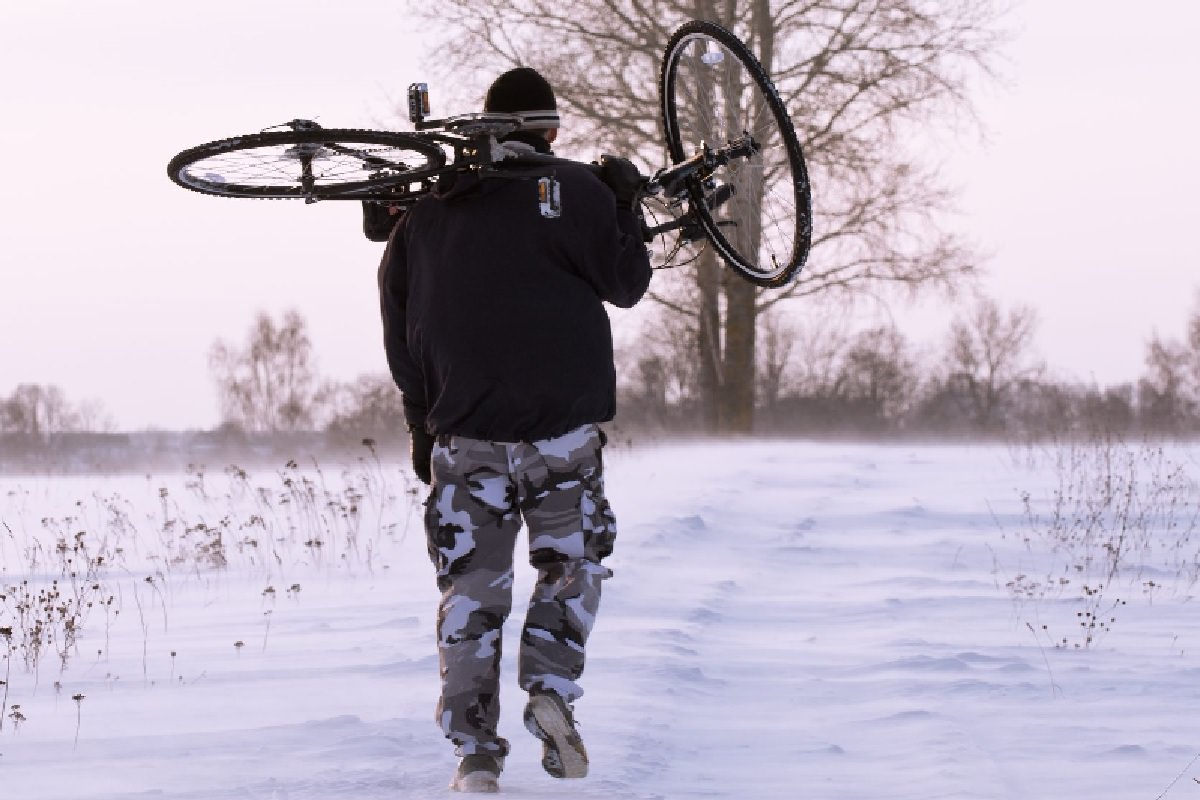
Anyone who has ever tried to ride in tight blue jeans knows it’s harder to pedal in inappropriate clothes. This can affect the upstroke where your leg is generating little real work anyway.
The difficulty in finding good cold-weather riding tights may necessitate the use of clothes designed for other sports, or several layers of tights and long underwear. Even when super cold weather tights are found, they are somewhat more bulky and can add to the effort involved.
This is hard to quantify because there exist no measurements of how hard it is to bend your leg. I asked a Physical Therapist if there existed such a measure. She just laughed at me.
Many riders report increased resistance well before the need to break out the stiff winter tights, often beginning to be noticeable at just above freezing. So while this is a real problem, we are going to give it a lower effect rating because we just can’t measure it.
Estimated Maximum Effect: 1%
7. Discomfort Avoidance
I often find I am reluctant to work hard and generate a sweat when dressed for cold weather. Let’s face it, despite the claims of breathability. of modern fabrics, they don’t start breathing until the “microclimate” inside of them is way warmer and wetter than you would like. I imagine that a hot muggy day in Alabama might be almost as appealing for a workout.
I will be the first to admit that this may be an indication that I am overdressed for the conditions at hand (and still they ask “Aren’t you cold out there?”)
It is strictly a psychological barrier, and winter cyclists can do something about it such as gauge the temperature more closely, and you can force yourself to work harder. Still, it does present a deterrent, although I would be hard-pressed to rate it or measure it, I don’t think it is a real significant.
Estimated Maximum Effect: 1%
8. Higher Winter Air Density
Air density can play a surprisingly large part in winter cycling. Winter temperatures in the range experienced by icebikers can drive air density up significantly.
As air gets colder, it gets more dense. There are more atoms of the various composite gasses and water molecules occupying less space. Per unit of volume, the air weighs more. At left is a table of air density values in Kilograms per Cubic Meter of air. At 77 degrees (F) one cubic meter of air weighs 1.18 Kilograms. By the time you down to Minus 40, it weighs 1.5 kg.
If your frontal area when on your bike is one square meter (probably close) and you are moving at 25kph (15.6mph), you will move about 7 meters a second and you will push 8.26 kg of air out of the way every second. That’s in summer. In winter, at about 5 degrees (F) (-15C) you must push 9.57 kg out of the way every second. That’s 15% more work every second.
If you are used to a level of effort sufficient to carry you comfortably along at 20mph (32kph) you will find you have to work 15% harder or accept a speed of 17mph (27kph).
At lower temperatures, this additional effort can amount to over 25% more work. When combined with other factors that slow you down in winter, this can be a significant impediment. Icebiking should make a great training program.
Note: Cold air can hold less water vapor than warm air. Water, as we all know, is heavier than air, but water vapor is lighter than air. As a consequence, moist air is lighter than dry air. These tables and graphs were calculated for sea level and zero percent humidity. If you factor in the moisture content of summer air, the density could well be less than 1.18kg per cubic meter. Since winter air is usually very dry at low temperatures, the difference in air density may well be more than this conservative analysis points out. The effect of water vapor is not great, which is why it was factored out of these figures.
| Degrees F | Degrees C | Air Density (kg/m3) | Percent Chg. |
|---|---|---|---|
| 77.0 | 25 | 1.184 | 0.00% |
| 68.0 | 20 | 1.204 | 1.71% |
| 59.0 | 15 | 1.225 | 3.47% |
| 50.0 | 10 | 1.247 | 5.30% |
| 41.0 | 5 | 1.269 | 7.19% |
| 32.0 | 0 | 1.292 | 9.16% |
| 23.0 | -5 | 1.316 | 11.19% |
| 14.0 | -10 | 1.341 | 13.31% |
| 5.0 | -15 | 1.367 | 15.50% |
| -4.0 | -20 | 1.394 | 17.79% |
| -13.0 | -25 | 1.423 | 20.16% |
| -22.0 | -30 | 1.452 | 22.63% |
| -31.0 | -35 | 1.482 | 25.21% |
| -40.0 | -40 | 1.514 | 27.90% |
Estimated Maximum Effect: 10 to 20%
Are We Slower?
There is one school of thought that holds that we are not indeed slower at all, and any difference in speed is comparing apples to oranges in that we are riding different equipment (mountain bikes instead of road bikes) using different tires (fat tires, perhaps with studs rather than road tires) and carrying more weight of clothing, boots, etc.
Now I won’t volunteer to do a time trial on my road bike, at 5 degrees, dressed in my summer shorts and short-sleeved jersey in winter. And I admit, that when pressed for time or feeling spunky, I can still achieve my summer speeds on my road bike in winter.
But it’s a lot more work. I’m about 3 to 5 mph slower in winter riding the same bike and the same tires. If I switch to my studs the difference is greater still. These numbers seem to agree with those reported by other members of the Icebike mailing list. We do indeed seem slower in winter!
FAQs
Is cycling in the cold more tiring?
Yes, cycling in the cold can be more tiring.
What temperature is too cold for cycling?
Temperatures below (0°C or 32°F) are considered too cold for cycling.
Is winter bad for bikes?
Yes, winter may be bad for bikes because the lubricants thicken in the cold. Moreover, the asphalt salt on the roads can cause corrosion.
Conclusion
If we take just the two big ticket items from the above list, Higher Air Density, and Less Aero Shape (drag) we have forces at work (and some numbers to back them up) that can account for 15 to 30 percent greater effort to maintain the same speed, or 15 to 30 percent reduction in speed.
So using these numbers, a 20mph rider gets reduced to 14 to 17mph (30% and 15% reduction respectively). The 17mph rider gets knocked down to 14 or even 12 mph. We have therefore accounted for typical speed reductions reported by die-hard icebikers, without having to resort to the use of those factors of which we are unsure.
When you add to this an allowance for lower tire pressure, the added rolling resistance of studs, the increased wind in winter, and the effort needed to plow through snow or slush you will see that there is ample reason that We Are Indeed Slower In The Winter.
Also Read:
- 15 Best Bikes For Heavy Riders
- How To Do Winter Cycling In Ice And Snow
- How To Do Winter Road Bike Training With Rollers
- Real Winter Biking – This Is How You Cycle In Really Cold Weather


11 thoughts on “Real Reasons Why You Are Cycling Slower In Winter”
never mind about the number of restriction in cold weather – ice cold weather is not good for your lunges
Why should it not be good for your lungs?
Here in Denmark we let our small children sleep outside, http://www.bbc.com/news/magazine-21537988
Its the deep breathing required when cycling – when outside walking at a normal pace the lungs are not affected – deep breathing taking in large volumes of ice cold air is a shock to the heart – that is why it is bad for people with heart complaints to go out in ice cold weather. I am a long distance cyclist and cycle between 4 and 5 thousand miles per annum – but in winter on very cold days ( sub 35 f ) – use my turbo trainer.
Well, from experience, one is much slower in winter training rides than in summer for sure. You only have to see and feel the difference when the first warm days of spring arrive and you can shed the winter gear – fitness jumps up – muscles simply work better for me. Then it jumps up again in the best of the summer months…part mechanical, part psychological too of course. It happens year in year out for me…science or not, it’s just the way it is and I look forward to those days. Nice post!
Breathing in cold weather is not normally an issue. I lived in Fairbanks for many years and ran in sub-zero temperatures, down to ~-50°F. The Iditarod and Iditabike are real things. Mushers run, they don’t just ride on their sleds. The more you do it, the more you’ll harden up. It’s an adaptive process. Most people greatly overdress.
The factors discussed above are certainly overestimates for wet or dry pavement. My average speeds go down very little, if any, from 70°F to 35°F. Once you get into studs and heavy Arctic garments it’s another story.
Thanks for this overview. It helps overcome the frustration that I’m so slow in winter 🙂
I recognise all of it. What you didn’t mention is prudence, riding a bit slower to reduce chances of falling, especially in corners of course but also on straights when it’s wet or when there are leaves rotting on the road. I also have different tyres in winter and they are heavier. You’re probably right in singling out heavier air and more drag, I’lm surprised how much difference that makes. Add to that the frustration of being slower and all the nuisances of riding in winter and it feels even harder than it is. But still I prefer rinding outside over the rollers!
It’s awesome to pay a quick visit this web site and reading the views of all friends concerning this paragraph, while
I am also keen of getting know-how.
I really enjoyed this article as I’ve been doing some of my own research and trying to quantify the speed reduction. I agree with an earlier commenter that many of the reductions above are overestimated. My experience and doing some rough calculations with my power/speed data shows roughly a 1.5 – 2 mph reduction in speed when riding in 70 deg versus 30 deg conditions (roughly 18.5 mph to 17 mph for similar power). I believe the primary causes would be air density increase, bulkiness of winter clothing, and increased rolling resistance. Again, great article.
30% more effort at same speed absolutely does not mean 30% reduction in speed. I don’t see how an actual cyclist could say that. At high speed (30 km/hr is enough) force is dominated by wind resistance and is speed squared. power is speed times force so is speed CUBED! That means a 30% increase in required power equates to about a 10% reduction in speed. Absolutely backing off from 33kph to 30 kph (a 10% difference) feels like about a 30% reduction in effort, and it is.
The pollution from cars and wood stoves are also slowing me down. It seems to linger in the cold air.
Of this were true, then climbing hills would have the same difficulty. This isn’t what I have observed.