

I rather suspect that, in the end, almost any bike can be used. What do you say? You can go winter cycling on your summer bike, even your skinny tired road bike. Some icebikers prefer just that. Cuts through the snow, down to the traction, they claim.
It’s not till you experiment with something else that you can determine that what you are using is better or worse. This is why it is desirable to try different bikes, lights, tires, etc. All this can get expensive. That’s why I offer these opinions. I am trying to save you money.
So, I am going to cover the different types of equipment that I and my fellow icebikers have used and you can use them for icebiking too. Now, you will find a wide variety of opinions on the topic of equipment. Don’t get confused. These opinions are so diverse, that you eventually conclude that they can’t all be wrong. There must be multiple “right” solutions.
The Must-Have WinterCycling Gear
Having said that, let me put in a plug for spending a little money. If you cycle commute, the money you save over driving a car will allow you a few luxuries, not to mention a few necessities.
Since winter and darkness go hand in hand, you deserve a set of good bike lights. They are required by law for night riding in most jurisdictions. If you want to survive to brag about cycling through the winter, you REALLY must have a good set of lights.
1. Tires and Wheels
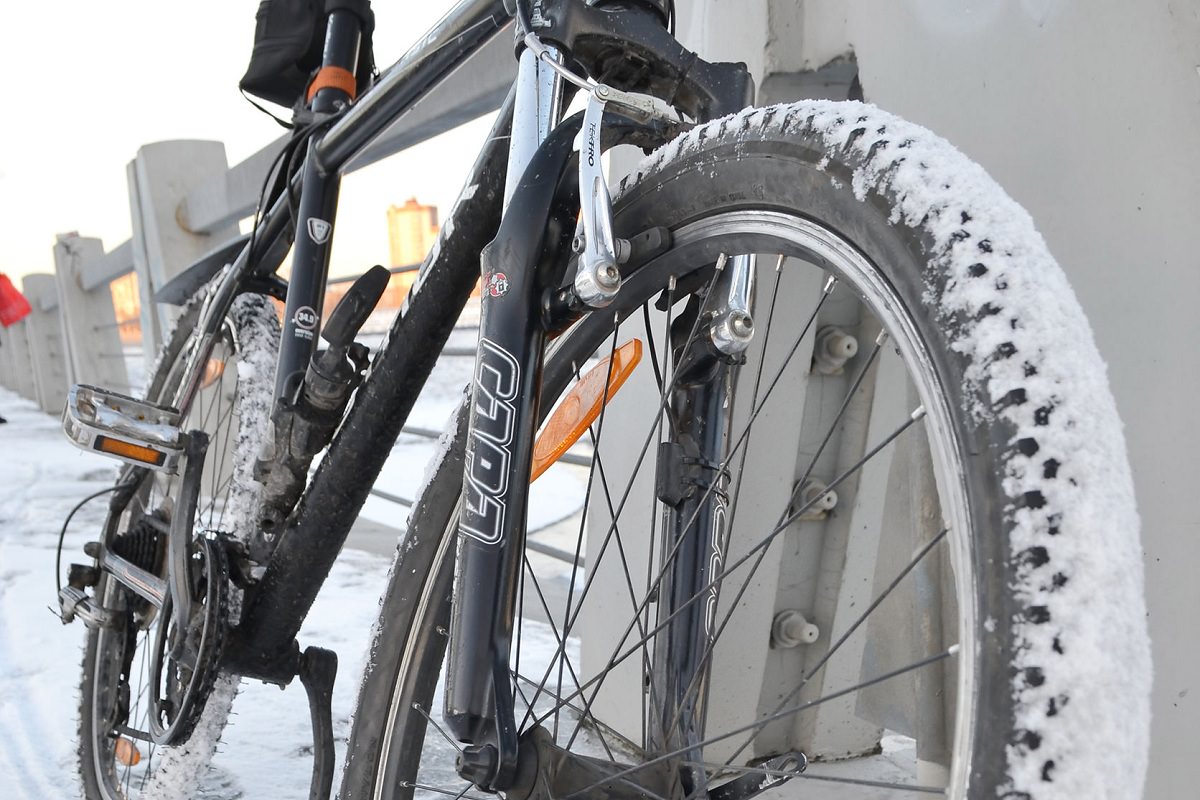
Wider tires and rims are becoming more available in commercial sizes (mostly mountain bikes, but also some street bike sizes). On packed snow trails or other conditions where the surface is quite hard staying on top can be practical with currently available tires.
No one expects to achieve flotation in all snow conditions. However, many would like to extend the envelope a bit and be able to stay on top of wind-packed snow, or the freeze-thaw crust that can form on wide expanses of snow such as on lakes or rivers.
Snowmobile trails provide access to areas not normally available to cyclists. These can be lightly packed after the passage of one or two snowmachines, and as hard as ice after a week or two of constant traffic. In between, they can still be miserable to ride with normal bike wheels.
Some attempts have been made to design a bike that can handle these conditions. Hanebrink Cycles has been designing what are billed as “snow bikes” for some time. Recently Hanebrink has been working with the Art Institute of Pittsburgh on the design of a bike for the Antarctic research station at Mcmurdo Sound.
The wide tires seen on the Hanebrink model are an attempt to extend the range of snow conditions that can be handled (just like fat bikes). While they will not provide flotation over a field of undisturbed snow, they will keep you from digging in or washing out on snowmobile trails and over thinly covered rivers and lakes. These bikes, prototypes really, cost around $3000 and are not yet in wide-scale production. See Hanebrink’s Website.
Even while remaining with the more traditional diamond frame, there are significant improvements that can be made to wheels to provide better service in winter. A full discussion appears on our winter tires page.
Replacement of rims with very wide rims, and use of extremely low-pressure tires, and Disk Brakes (see below) work to eliminate many of the problems associated with traditional equipment in winter conditions.
2. Power Trains
Power trains on icebikes have been problematic. Several winter cyclists report good results using internally geared rear hubs. This allows a bike to be built without a rear derailer.
Hubs by Shimano and similar models by Sturmey Archer provide 5 to 7 speeds (a higher number of speeds may be available soon) have the advantage of lower maintenance, and some have indicated, less probability of freeze-up in the slushy weather.
Rohloff in Germany manufactures a 14-speed unit which would give you a full range of gears with no front derailleur to worry about. See their website.
This unit is built for racing and can handle the stress of heavy acceleration. Gearing charts are available on their site. Weight is only about 200 grams more than a high-end derailleur-equipped bike.
It has been said that the really cold weather performance of these models can leave a lot to be desired. Internal resistance can increase dramatically at really cold temperatures. If intended for cold weather use, manufacturers may be able to recommend lighter-weight lubrication.
However, at typical icebiking temps, the resistance is generally not too bad if the bike is not left out overnight, as a warm hub tends to stay free moving by being ridden. These newer hubs approach, but do not yet equal the efficiency of the derailer about drive train-induced friction.
The other advantage of the internally geared hub is the ability to install an enclosed chain line. Once you are free of derailleur (front and rear) there are no lateral movements to the chain. This makes enclosure possible. Enclosures eliminate road grit accumulation and reduce maintenance needs.
3. Braking
The internal geared hubs typically do include a hub brake, which can eliminate another winter problem. Rim brakes can freeze in wet weather or slushy snow. Extended periods of braking can warm your rims enough so that they will melt snow and this leads to poor braking.
Worse, if they are allowed to freeze again you will have a thin layer of ice on the rims making for really hair-raising braking. This can be overcome by simply dragging the brakes for a while, or solved by the use of disk brakes or hub brakes.
Disk Brakes are finding favor with many off-road icebikers. Usually hydraulically operated, these do carry a small weight penalty impose some constraints on frame design, and complicate wheel building. However, they do provide excellent braking, and eliminate the icing problems of rim brakes.
4. Lights
A custom bike might require a custom bike light, one that can keep going as long as you have the energy. Although not the brightest of lights, or the widest of beams, hub generators may be just the solution for long-distance icebiking in the dark months.
Unaffected by cold, and with no run-time limitations the hub generator is always ready to go. There is a slight drag penalty, even when the hub is not generating power, (about 2 watts, cyclists normally are capable of sustaining around 100 watts, with a surge capacity of 150 watts), not something you will notice. When generating power, the drag increases to about 8 watts.
Fully enclosed, and weather-tight, these generators do not rub on your tire like the old-style generators. They weigh a hefty 610 grams. Subtract about 140 grams for the regular front hub they replace, then subtract a pound of batteries (450 grams) and you are within 20 grams of parity.
The downside: Light output is not what you would expect from a 30-watt battery unit. Neither in intensity nor coverage. Plenty good enough for road cycling, you would probably not want to tackle any single track at night due principally to the narrow beam. On a white expanse of snow, this may not be a problem.
Winter Cycling Gear For Carrying Stuff
Carrying stuff on your ice-bike outings or commuting is not a lot different that summer except that you are bundled up to a greater degree, and what you need to carry may be more bulky as well, especially if you carry extra layers of clothes or a change of clothes for the office.
1. Panniers
Winter or summer panniers work well. Waterproof ones are pretty much necessary in wet climates, but other than that icebiking imposes no special requirements unless you intend to ride in deep snow. Then the side mount panniers are going to snow-plow.
The rear-rack mounted “trunks” are also popular and they carry quite a bit of stuff. The problem with racks attached to the bike is that in winter you are more likely to want to bring the entire pack indoors. The ease of attaching and detaching with gloved fingers bears consideration.
2. Backpacks
Backpacks have the distinct disadvantage of adding weight up high, thereby raising your center of gravity. This requires large steering movements to balance the bike. In winter they can be hard to get on and off over heavy clothing.
They are easier to carry with you, as you do not have to remove them from the bike. Many icebikers use the Camelbak type of hydration system, which often has pockets for carrying small items.
3. Fanny packs
Although limited in size, these have an advantage in that they are worn lower than backpacks and are easier to buckle on over winter biking wear.
My favorite fanny pack has a backpack built into the top flap so that if you suddenly find yourself with too much to carry you simply unzip it into a backpack (and then struggle to get it on over your winter togs.)
Bags
I have to carry my lunch and a change of clothing to work so I’ve become an expert in “space management” (stuffin’ junk). For the bike I bought a seat post rack with a quick release, nothing fancy.
$15.00 at, – ready for this … Toys R Us. I looked at many others at twice the price, and it works great as a fender. For the rack I use an insulated canvas bag (about $15.00-20.00) about 12Lx6Hx5W, again available at most department stores in the camping section.
I recently bought a Jandd “Hermon Monster” bag (about $65.00), Based on the Alice military bag, you can also purchase load straps from Peal Izumi or go to a military surplus, it has great lumbar support and a padded waistband and 600 CI of space.
Economy: Go to Wal-Mart, K-mart, ShopKo, and go to the fishing section, there is a canvas hip bag (black or commo) that has a large main pocket and several small pockets on the waist strap (for under $25.00). There is no support and there is a fuzzy patch for hooks that is easily removed, but still a good solid bag.
John May
What Type Of Bike You Will Need?
While almost any bike will do for icebiking, what would the ideal bike be, if we could design one from the snow up?
Much speculation about what would constitute an ideal design for snow and ice conditions has occurred in discussions with other winter cyclists. Some of these ideas include attempts at flotation (wide – really wide) tires to attempt to stay on top of snow, if not all snow, then at least the more packed variety. Also high on the list of desired items is a foolproof and freezeproof power train, better brakes, and pedals that can accommodate a variety of different boot styles.
Is one enough?
The second item to consider is another bike. If you live where conditions can vary dramatically from day to day or week to week it is sometimes a good idea to consider investing in a good quality (perhaps second-hand) bike that can be equipped differently.
For example, if you live in a maritime environment, where you might have icy frozen roads followed next week by rain, having one bike equipped with fenders and another equipped with studded tires is not unreasonable. Alternatively, you could change tires (what a pain) or have an extra set of wheels for the same frame.
With two bikes, in addition to having a backup bike, if one breaks down, you have a choice of bikes and are better equipped. A second-hand bike can be had for anywhere from $75 to $350, depending on what you want. A little re-equipping and you can have a rain bike and an ice bike.
The downside: storage, a duplicate set of lights, a computer, a pump patch kit, etc. There are more expenses than you think. But, hey, you’re worth it, Right?
The Verdict
So if we were to combine all of these things in a new design from scratch, would we have a suitable winter bicycle? Probably not. Or, at least, not for most conditions, but perhaps suitable for specific terrain. On-road use of very wide tires would slow you down considerably.
Internally geared hubs, on the other hand, excel in the gritty wet on-road environment. They don’t remove the requirement for chain maintenance, but the static chain line allows closer fitting of fenders.
However, for trails and off-road areas, the Hanebrink design holds promise. It does not appear to be a fast bike, but the additional areas opened up, especially in snow-mobile country, may make this sort of bike a desirable addition to your stable. In summer it could be used for beach riding and other areas where soft sand challenges traditional bikes.
Also Read
- Winter Cycling Clothes – The Ultimate Clothing Guide
- How To Layer Winter Cycling Pants And Tights
- How To Choose Between Winter Cycling Gloves, Pogies And Mittens
- All You Need To Know About Winter Cycling Caps, Hats And Headgear
