

Cycling mirrors are one of those subjects that bring on arguments almost as intense as the “Helmet Wars” found in any cycling discussion on the Internet. They come around once every 6 months or so and usually leave a lot of acrimony hanging in the ether. Roadies think they are too sexy to use mirrors, mountain bikers don’t need them and break them too often anyway. Since bicycles come without any bike accessories like bike bells or rearview mirrors the roadies think they are not needed.
But bicycle commuters and recumbent riders seem to gravitate toward mirrors sooner or later. So if you are not disposed to reading the ranting of a mirror advocate it is time to click another link and surf to some area of agreement. This page is for mirror users or those investigating various types of mirrors in anticipation of a purchase.
An Analysis Of The Different Types Of Bike Mirrors
There are 4 different varieties of bar-end mirrors. Cycling mirrors all of which are inexpensive, usually under $20, most under $10. Each type has different characteristics of clarity, mounting, vibration sensitivity, and susceptibility to frost/fog in winter conditions.
1. HandleBar Bike Mirror
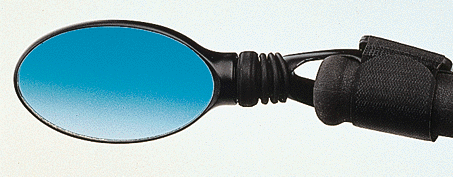
Handlebar mirrors are designed to fit on the end of your handlebars and stick out further than the widest part of the rider. There are various attachment methods, some simply replace the end-plug of your mountain bike bars, others come with swing-away hinges, etc.
Pictured is a Rhode Gear mirror that mounts with Velcro. These are appreciated by cyclists who ride the same bike all the time, and/or those who do not wear eyeglasses or helmets suitable for other types of mirrors. They may ice up if you leave your bike out in the cold, but you can usually warm them with your hand.
Although most roadies avoid mirrors, Rhode Gear makes one that fits the hood covers of drop bars. It is probably one of the best for the full tucked position, in that your sight line is often blocked by your shoulders with other mirror types.
The drawbacks of handlebar mirrors are that you generally have to buy one for each bike you ride, and they do not transfer easily. But Rhode Gear pictured above attaches with Velcro and is easy for you (or a thief) to move to another bike. Further, when the bike tips over and impacts the ground the handlebar mirror usually hits first. Some have swing-away mounting, and most just have “breakaway” mounting.
Since it is mounted on the handlebars it is subject to vibration. This can make the image useless unless the mounting system has some built-in damping. You may have to move your head or body to see what is behind you, and in extreme cases, you will have to steer the bike to maneuver the mirror.
Finally, they require that you take your eyes away from the road ahead to see what is behind, although this can be done quicker than a head turn.
3. Helmet Mirrors
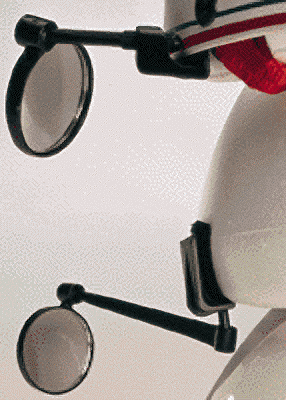
Helmet mirrors come in two basic types which differ predominantly in the mounting system. One system mounts on the hard shell, usually with a screw clamp arrangement. The other mounting system (which can be used on almost all helmets) is a glue patch.
The mirror is positioned via a stalk above and to the left or right of your eye. The helmet mirror sits well outside your hood, balaclava, and helmet and usually, the only view obstruction will be your shoulder or “big hair”.
A simple 10 to 20-degree turn of the head allows a full sweep of what is behind you. These are cheap and easy to attach and are always with you regardless of which bike you ride – as long as you wear your helmet. If you have two helmets, avoid glue mounts. Those that screw-clamp mount on the helmet shell may not be reversible, so be sure you order it in the country where you will use it. The ones sold in the USA are made for riding on the right side of the road.
The downside of helmet mounts is that you must be careful when setting your helmet down. It is sometimes difficult to get a good mirror placement because of inconsistent helmet position or because the mirror is too high due to the fit or shape of the helmet body. If your helmet moves around even a little on your head your mirror will be out of position part of the time. There tends to be more vibration in these mirrors than in those below.
3. Eyeglass Mirrors
Eyeglass-mounted mirrors attach to the temple or bow of your eyeglasses or cycling glasses. They typically use a three-point mount along the left bow (or right side for those who drive on the left). These generally position the mirror either at the same level as the eye (or slightly above) and just far enough to the side to clear your helmet and balaclava. When riding with a hood on, it is occasionally necessary to adjust the mirror and turn the head slightly more to accommodate the extra bulk
Again, a simple 10 to 20-degree turn of the head allows a full sweep of what is behind you, and a 45-degree head turns to let you see what is on your right. Eyeglass-mounted mirrors tend to suffer less vibration than other models, you can often read the license plate of the car about to pass you. The positioning of the mirror is the best of all models.
4. Third Eye
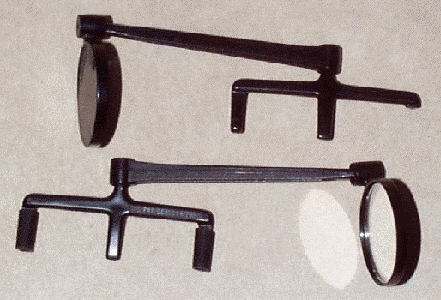
The company Third Eye makes eyeglass mirrors. Third Eye uses plastic mounts, and the part that attaches to your eyeglasses bow is rather weak. I have had several pairs fail while trying to attach or remove them, most often in freezing weather.
The adjacent picture shows the most common failure mode, where one of the three-point-attachment legs breaks off rendering the mirror useless. This is part of the design, it is intended that the mirror break away here in the event of a crash rather than in front of your eye.
Third Eye will honor the warranty, just mail the broken parts back to them. I sent in a couple of broken mirrors and they sent me several extras of the three-point-attachment parts which can be snapped together with the shaft and mirror.
5. Take A Look
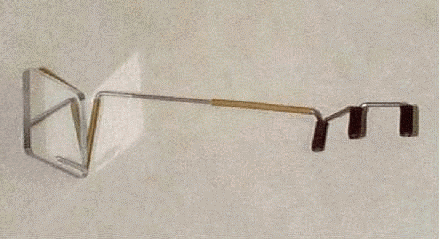
Manufactured by Bicycle Peddler of Greeley Colorado, these are the finest bike mirrors I have run into. Impervious to the cold, all of the critical parts are metal.
The three-point mount is a single piece of metal and is designed to be bent at specific places to accommodate wide or narrow glass bows. The mirror can be rotated on three axes, and the entire assembly can be flipped upside down and mounted on a helmet shell. The un-framed mirror is acrylic. They are unconditionally guaranteed by the manufacturer.
These are very clear, with hardly any vibration, and far more adjustable than other eyeglass mirrors I have run into. They provide a larger field of view than most other helmet or eyeglass mirrors and require less head movement than any other mirror I have tried. The mirror, being plastic can be scratched with rough handling, but it survives drops well.
6. Cycle Aware
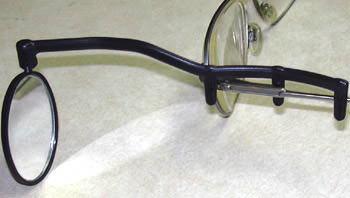
Cycle Aware is a relatively new manufacturer of cycling mirrors and they offer a product in each of the categories on this page, handle-bar, helmet, eyeglass, and on-lens. I tested the eyeglass model and found a new twist. Twist, Bend, and Adjust, but no break. The main stem of these mirrors is made up of a bendable plastic that is supposed to retain its shape after being bent to fit your glasses and position the mirror. Being a little timid about bending plastic parts we approached the task carefully.
I also found that I can make adjustments without breakage. The stem did tend to retain its bend for some time, although after many days it need adjustment. I haven’t tried this adjustment in freezing conditions, it seemed wiser to do it indoors.
The fingers that hold the mirror to your glasses are beefy and have a non-slip pad built in that does not come off and get lost like some others. These are very strong and you can bend the main shaft between the fingers to achieve a tight fit.
Note that the mirror is an OVAL shape, and is more vertically oriented than others such as the Take A Look. I think this is a mistake and the mounting stud on the rim of the mirror should (in our opinion) be positioned halfway between the end of the mirror (where it is now) and the side of the oval so that you could position the mirror in a more horizontal orientation and thereby achieve a wider viewing angle. Other than that I found the mirror stable and the mounting sturdy.
7. On lens mirrors
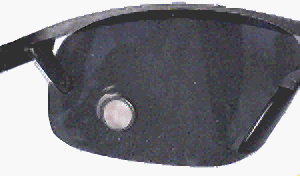
The final category of cycling mirrors is the on-lens mirrors. These are very high-quality mirrors that attach directly to the inside of your eyeglasses. They are very small and have an adjustable swivel base.
Several companies make these, including Third Eye. These mirrors, although meant for eyeglass wearers, will not work if you need the correction supplied by your prescription lenses. The image in the mirror does not come through your prescription. They are best used by cyclists wearing sunglasses or who do not need correction for distance vision. They will not work with wrap-around sunglasses.
Since these sit inside your glasses your rearward vision is blocked by your head, and you will have to turn your head considerably further to scan traffic to your rear than you would with a helmet mirror or eyeglass mirror. But they are hardly visible behind a pair of sunglasses. Great for the aging roadies who do not want to be seen wearing a mirror, but find the head turns more difficult with each passing year.
Explore our guide to know the true purpose of cycling caps. Do you really need them?
Cycling Mirrors Arguments: What’s Really The Truth?
1. Loss of eye fears
One reason that non-wearers frequently give for not wearing helmets or eyeglass mirrors is the fear of losing an eye in a crash. I have no statistics on this, nor have I ever heard of an incident of this happening, but I would bet that somewhere in the world it has happened. There is no history of litigation on this matter, so it must be extremely rare.
Eyeglass wearers are somewhat protected by their prescription lenses (you ARE wearing plastic, NOT glass lenses aren’t you?) so one would imagine this danger would pertain more to helmet-mounted mirrors if it exists at all.
In the one serious crash and several minor ones that I have experienced, my eyeglass mirror was never damaged or even dislodged. Yet, I have managed to drop one onto the only rock in an otherwise well-manicured lawn and broke the mirror. Go Figure!
Ride safely in the dark with our top-rated bike lights, batteries, and reflectors.
2. You Have To Head-Turn
The other reason frequently given for not wearing a cycling mirror is the need to do a “head turn” to be sure nothing is behind you. Generally good advice, nothing wrong with being safe. I do it myself most of the time. The problem is, this bit of advice is often put forth with self-righteous vehemence based on superstition and habits formed from driving automobiles, and always by someone who does not wear a mirror, and probably never tried one.
Most drivers have had an experience of peeking in the mirror, and starting a merge into the left lane only to hear the irate blare of a horn from another motorist lurking in the “blind spot”. However, with a helmet or eyeglass mirror, THERE ARE NO BLINDSPOTS. A simple, quick 10 to 20-degree turn of the head provides a full rearward scan, curb to curb with no place for a car or even another bike to hide.
3. Are They A Distraction
You will occasionally hear people rail against mirrors because (they claim) the mirror distracts you from watching the road ahead, and you spend too much time looking behind you. Right! Yet they are required by law on every motor vehicle and even jet fighter aircraft use them! This argument is often put forth by the same people who insist you have to do a head turn. The fact that a head turn is far more distracting than a peek in the mirror never even occurs to them.
If they spend too much time looking behind it is because they have never tried a mirror long enough for the novelty to wear off. In a sense, this argument is essential that mirrors work TOO well. So well that you will not be able to concentrate on where you are going.
As stated above, after wearing one for a week, you will find it so natural, and so convenient, that you will wonder how you ever got along without them. You will feel positively naked without your mirror while in traffic. You will even catch yourself peeking to your upper left while walking down the street.
4. Loss of communication
Finally, there is the turn your head to “communicate” with motorists argument. That says your head turn will tell the blue-haired lady in the Suburban exactly that you intend to turn, and she will instantly understand and grant your wish, even though she hasn’t been on a bike since the 6th grade.
Non-cyclists have no idea why you turn your head, other than to believe that you turned and you saw them and are therefore responsible for avoiding them. If you wanted to turn, you would have signaled! That’s the law. That’s what they expect.
So the mirror lets you see, your signal lets them know, and your head turn satisfies your fears and superstitions regarding ghost cars that don’t show up in mirrors. Uncharitable characterization? Perhaps, but no less so than those used by the anti-mirror crowd, one of whom writes “Cyclists who have developed their worries more than their skills are strong advocates of rearview mirrors…”.
Stay informed about bicycle laws and ride safely on the road. Read our comprehensive guide on the safety impact of bicycle laws.
FAQs
Are bicycle mirrors a good idea?
Yes, bicycle mirrors are a good idea because they help you ride safely on the road.
What type of mirror is used in bikes?
A convex mirror is used in bikes.
Why do professional cyclists not wear mirrors?
Professional cyclists do not wear mirrors to keep their bicycles as light as possible.
Recap
When you are all bundled up with a balaclava, a hood, or if you are using bike helmets, it is somewhat more difficult to turn your head to see what is approaching from behind. If you wear eyeglasses, depending on your prescription, you may have to turn your head farther than other cyclists to look out of the lens rather than beside it. This is especially true of near-sighted cyclists as the image presented when peeking out beside the lens is often useless.
In heavy traffic conditions, where lane changes are required, knowledge of traffic conditions to the rear is usually essential. At other times you just want to monitor the motorists behind you to get a little advanced warning about passing cars, turning cars, and bow wave blasts of wind from trucks.
There have been many days, usually in heavy snow, that I feel far more comfortable keeping my eyes on the road and determining when it was safe to move left with the mirror than taking the risk of hitting a snow rut while trying to do a proper head turn in winter clothing.
So it is up to your comfort. Do you feel more comfortable twisting your neck as back as you can or do you find it better to rely on a mirror? Let me know in the comments below!
Also Read:

19 thoughts on “What You Need to Know About Cycling Mirrors”
I also find Forester’s reasoning to not use a mirror quite flawed. If his reasoning was logical then we do not need rear-view mirrors in cars either.
I agree that all cyclists (and motorists) are to turn their heads before changing lanes (and they should also use their hand signals/turn indicators) but with a mirror, one can easily see when their is no need to look behind & take one’s eyes off the road as one can keep their head forward-facing and see an approaching vehicle from the rear thus needing to turn one’s head only when one does not see a vehicle.
Additionally, Forester’s claim that one can see curb to curb by turning one’s head and judge motorists speeds ignores that to do so means having one’s head turned for observation for a significant time. This means not watching the road and cyclists ahead of you far a significant time.
“Significant time” does not mean ten seconds. It means enough time to see all vehicles and judge their speed of travel as safe or unsafe. It could mean as little as one second or less and a lot can happen in the group ahead of you in one second or less.
By having a rear-view mirror, one reduces the amount of times one has to turn one’s head (by only turning if the mirror appears clear of traffic) and the amount of time spent turning one’s head as one already has an idea of what vehicles need one’s attention when one does turn one’s head back.
I am an advocate of turning the head to look behind but I am also a big advocate of glasses/helmet mounted mirrors.
I must confess that I haven’t read Forester’s book myself, but I also think it makes sense to use cycling mirrors.
But only when doing road biking, etc. outside the city. In the city, I think it makes more sense to turn your head to make sure no communication is lost.
First off, Foresters proscription against cycling mirrors was from a time when helmet mirrors were at in their infancy, and Forester was in perfect health. Bike mounted mirrors induce all sorts of unpredictable lateral movements as cyclists attempt to focus the road behind in the mirror, where as a simple head turn would suffice.
In subsequent writings, he reevaluated his stance on mirrors in light of his advancing age, and the difficulty of turning his head sufficiently to establish eye contact.
As for just exactly WHEN to yield to following traffic (appears elsewhere in this discussion thread), that is yet another large debate.
From the US, where cyclists have full legal rights to the road in most places, my take was to be in no particular hurry to scurry to the shoulders, and I would, in fact, often move toward the center of the lane when an approaching driver did not seem to be aware of my presence, was approaching too fast, or too close.
This act (always executed with sufficient margin of safety), communicates clearly to the motorist that this is YOUR lane, and you are TAKING it. It works very well to elicit reduced speed, wider clearance, etc. After the desired response from the motorist, I would (where, and when possible) move toward the shoulder, as a matter of courtesy.
Of course you have to be aware of the law of gross tonnage, and the last thing you want to induce is panic braking of an 18 wheeler. Exercise early, and conform to your local laws.
Thanks John, but it sounds rather scary to move to the center of the lane. Especially when the driver is approaching too fast etc.
Why not move to the shoulders instead? Is that because you consider moving to the shoulders more dangerous than moving to the center of the lane when the driver doesn’t seem to be aware of you?
The common perception of new cyclists mixing with traffic is that the lane is dangerous and the shoulder is safe.
There is another site which has at least one good article that explains the concept quite well.
I highly Recommend this article
http://www.bicyclinglife.com/PracticalCycling/VCIntro.htm by Lauren Cooper.
Key to this practice is, as you suggest, the realization that the the risks are not always as we perceive them. The other key is taking your lane at the opportune time, with no surprises for the drivers. (The head turn, the signaled lane change, etc.)
We are far more likely to get hurt at the side of the road, by turning traffic, parked vehicles, opening car doors, road debris, than we are in the center of the lane, with following traffic which is made fully aware of our presence.
Interesting link. Thanks.
Playing chicken with an approaching vehicle while riding bike is like bringing a knife to a gun fight.
It might seem like commom sense. I would be interested about how to react based in what we see in the mirror. How close should we let a car follow before we move to the curb? If a car behind is traveling so fast and doesn’t seem to change lane or slow down, we should yield to them. Sometimes they don’t seem to notice the cyclist because they could have switched lanes. A mirror won’t do us any good if we don’t respond to what we see.
Out of the three mirrors I used, I prefer the mirrycycle because it withstands vibrations and can be rotated to protect it from being hit in narrow paths. If it breaks, you can buy replacement parts.
Thanks Brian. Good point that a mirror doesn’t do any good if we don’t respond to what we see.
John,
Agree 100% – as you can see from this blog post of mine:
http://www.virtuousbicycle.com/BlogSpace/bikemirrors/
Well done on summing up the pros/cons of mirrors.
Best,
Lance
Thanks a lot for your nice comment.
I have used an eyeglass mounted mirror since the 70’s—it has no doubt saved my life on occasions, and it is so lightweight as to be almost inconsequential. Since I don’t wander around without my glasses (I can’t see !) It has been the perfect solution for me (And, I can no longer twist my head about as I could 40 years ago.)
I know people who will still not wear a seatbelt, and many of which are police officers, claiming the excuse that it delays their ability to exit their vehicle. Never mind that they might be traveling at speeds in excess of 100 mph.
It seems to me that another advantage not mentioned of the glasses attached mirror would certainly be of it’s ability to be used during other activities not requiring the use of a helmet, instead of just biking, making the purchase far more justifiable initially. I can’t tell you how many times this would have come in handy for me as a kayaker, to be able to see boat traffic coming from behind me on a river, or lake. Much easier than turning to look over the shoulder with the hindrance of a bulky pfd on, or turning the kayak to see. In fact, in essence, it must also be pointed out that cycling beginners, people with limiting factors, such as physical limitations, and even overweight bikers which are very common, appear to be the ones who stand to benefit the most from having a bike mirror. It simply stands to reason that if it’s impossible, or at least difficult to turn, you’re not going to be safe, and a mirror is the only remedy for this problem, especially since such issues are usually the reason these people are biking to begin with. Of course, once the snobbish crowd of roadies see the fat kids using a mirror, they’ll probably never use one for sure. Yes, that schoolyard mentality appears to remain existent regardless of age.
Great article, thanks! Very helpful.
I’m the fat kid on the bike trails, sidewalks, and streets of Sarasota Fl, and have been using a handle bar mirror for 8 years+. I presently ride Legacy Trail with a small group of 55+ folks, and we crawl at times. “One Your Left!” is mostly what we hear for 10-17 miles. the only people we pass are moms walking kids in strollers and other older folks strolling side by side. With front and rear lighting I ride back of the pack and provide rear lookout, alerting the pack and approaching riders with a bell. If you ever want to experience rude fellow cyclists try riding two wide while sharing the 12′ wide R2Trail with riders cruising well over the 15mph posted limit zipping past with no warning, then growling “Single File!!” If they had a light on the front of their racing bike, I would have noticed them approaching at triple our speed, FGS!
I’m exploring mirror options for my new hybrid bike purchase. This clearly explained what I need.
Sorry to reply so late, just found this from a search on “cycling mirrors”. Got a question: Are there any eyeglass mirrors that work when the temple is very slender, practically a wire? My glasses are Silhouette brand, in case you know ’em — hingeless, very flexible titanium wire (slightly flattened) as the temple. I know this may be an impossible combo but I thought I’d ask.
Thanks!
Hurrah! In the end I got a webpage from where I can genuinely take valuable
information regarding my study and knowledge.
It’s strange that this article maintains that the only handlebar mirrors are ones that stick out of the end of the handlebar. Especially when one of the arguments against them is that you look too far away from the road. There are of course many handlebar mirrors that mount closer towards the middle, not just out of the end, and so don’t require you to turn your head as much (or even at all!) Perhaps the author dismisses them out of hand because this mount introduces the problem that your own arm or torso blocks the view in the mirror? A clever trick to get around this (one which I use) is to buy a mirror for the OPPOSITE side of the one you need (most typically a right-hand side mirror, to mount on the left side) and then mount it upside down on the other side so that the mirror is below the handlebar. This puts the field of view visible in the mirror between your waist and knees, which are much less obstructive.
Another case for mirrors is riding a recumbent. Even if my neck were still flexible, turning to look behind me on a recumbent is nearly impossible. The seat block my line of sight and interferes with turning my shoulders.
I tried handlebar mirrors on my first ‘bent, but the ones I could attach were of poor quality and broke in the slightest fall. I finally put in the time and effort to get used to a helmet mirror and am now in the “look in my mirror when I’m walking” crowd. I recently added a Da Brim, which makes helmet mounting harder, and so was glad to read the reviews of eyeglass mirrors.
Mirrors on bicycles mostly help to alert the rider when potential danger is nearing or present in back of them. The information from a mirror can keep a rider safer in the case, for example, if a piece of debris in the bicycle’s path must be avoided.
Turing the head is ok but not always required to determine if a vehicle is behind the rider. Nor is it required in a vehicle if mirrors are available to provide site in the “blind spot.” Long before semi trucks had cameras, they had convex mirrors to see into those “hidden areas” around the vehicle.